Wednesday, June 21, 2006

Away to France

Dear Reader,

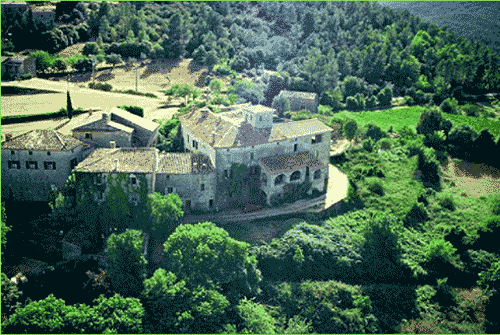
On Monday, I'm returning to Le Mazel:


It's the hamlet in the Cevennes mountains of France where I first came to know Mai Zetterling, a beautiful Swedish film actress who starred in a lot of British movies during the 1950s and 1960s:


Mai lived at Le Mazel until her death in 1994. The house stayed empty for five years until my cousin bought it, and when he took over, the place was still very much intact. Mai had left the place in a hurry because she thought she'd just be taking a quick trip to London for treatment of her cancer. She never made it back to France.

I lived at Le Mazel for three months in 2000, during my summer of love when I reinvented myself with the help of my bad girls. Needless to say, the spirit of Mai Zetterling was all around me then--I wore her hat, slept in her beds, sat in her chairs, ate off her plates, broke her wineglasses, read her books, and snooped through boxes of film stills and family snapshots in her office.

It's been several years now since I've visited Le Mazel, and I wonder how it will feel to go back there. I'll tell you more after my return to NYC on July 4. There will be no blog posts while I'm away. Part of Le Mazel's charm is that we have no computer, no phone, no television.

Cheers, Joyce Hanson

Sunday, June 18, 2006

Beautiful Lola, Scary Lola

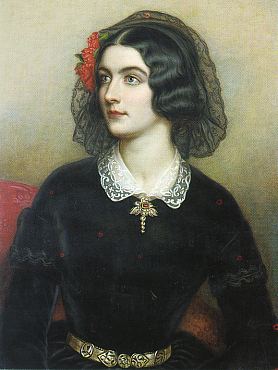
Lola Montez was a legendary beauty of the 19th century. Unlike our photo-filled era of gossip magazines and celebrity websites, in Lola's time there were few images available, and what people saw was usually painted portraiture. Or they relied on descriptions: "She was a very lovely woman with a magnetic personality," one writer said of Lola. "Her gait and carriage were those of a duchess," said another. She was a "singular and striking beauty," said a third.

When I first started my Lola studies, I was very curious to see what she looked like, and this was the painted portrait I kept coming across in books:


Wow, what an elegant beauty, I thought. Lola herself wrote a book, The Arts of Beauty, and chapter seven was devoted to "A Beautiful Face."

"If it be true that the face is the index of the mind," she said, "the recipe for a beautiful face must be something that reaches the soul. What can be done for a human face that has a sluggish, sullen, arrogant, angry mind looking out at every feature? An habitually ill-natured, discontented mind ploughs the face with inevitable marks of its own vice....If a woman's soul is without cultivation, without taste, without refinement, without the sweetness of a happy mind, not all the mysteries of art can ever make her face beautiful."

Oh dear. Need I remind you that Lola died alone of syphilis in the poorhouse when she was 43, having lived on four continents and gone through scores of husbands and lovers? Lola knew from discontent and vice. On first reading, her thoughts about a beautiful face come across as the prim lecturing of a Victorian lady. On second reading, knowing what we know about Lola's fate, her words are a desperate plea, the negative morality of a woman who fought the world every day of her life.

And then one day, I came across a biography that provided the first photographic evidence of what she truly looked like:


My heart skipped a beat. Oh my god, Lola Montez smoked! Her face was hard, with a mouth narrow and set, eyes hooded with contempt. She looked like a tough girl who would beat me up after school. Lola scared me. Was she a bad girl? Oh, I think so.

Ever since I've seen Lola's photo, I've tried my best to love her. But it isn't easy. She's not my favorite bad girl. I get the feeling that if I tried to put my arms around her to give her a hug, she would flinch and push me away, glaring at me with arrogance and anger and just itching for a fight.

Wednesday, June 14, 2006

Lola Montez and Me

Lola Montez features in the first chapter of my memoir. Called “A Mistress of Self-Invention,” the chapter shows how I’m at a turning point in my life. Even as I resist change, I can feel myself climbing out of the depths of misery with the promise of learning about bad girls. Over Christmas and into New Year 2000, I endure periodic, despairing phone conversations with The Ex-Husband Who Must Not Be Named, but I find that I’ve stopped obsessing over our failed marriage as my mind turns to thoughts of the wicked women I’ll be studying in England and France.

The questions come bubbling up: What is a bad girl? How does she become one? Are there any personality traits that all bad girls share? Who were the most outrageous bad girls of all time?

Chapter One details my fledgling efforts to discover the bad girl persona before I leave Chicago. Everyone I tell about the bad girls project throws out names I should look into. Marilyn Monroe (too much of a victim, I decide). Lucrezia Borgia (too violent). George Sand (too neurotic). Calamity Jane (too not sexy).

And then one day in a bookstore, I come across a name and a story that intrigue me: Lola Montez, whip-cracking virago of the 19th century.

“She has the evil eye and will bring bad luck to whoever links his destiny with hers,” the French novelist Alexandre Dumas Sr. wrote of Lola, and that feels right to me. Lola was a sex goddess with a penchant for self-invention, a frivolous bit of fluff who was deadly serious about her limited talents and over-reaching ambition. After mad affairs with virtuoso pianist Franz Liszt and King Ludwig I of Bavaria as well as several ugly marriages and a mediocre dancing career on four continents, Lola Montez died of syphilis in a New York poorhouse at age 43 and was buried in a pauper’s grave in Greenwood Cemetery, Brooklyn.

As a woman who made a glorious mess of her life, Lola appeals to me enormously. She feels like the start of my journey. I take perverse pleasure in learning that she, too, was a nice girl who married the wrong man because she thought it was a good idea at the time. For Lola, that rash decision ended in a scandalous divorce which forced her to reinvent herself in the 19th century, a time when divorce turned a woman into damaged goods.

Chapter One doesn't actually exist yet. I'm currently gathering my resources and courage to start writing it. This involves not only reviewing my notes on Lola, but digging through my thoughts and feelings, present and past, of what is and what could have been. Ugh.

Before sitting down to blog this morning, I went through a trunkful of memories that I've held onto for years and usually avoid like the plague. Datebooks, letters, postcards, journals. I'm trying to reconstruct my life as part of the process of writing a memoir. It's all so cringingly personal and SELF-INVOLVED to see what I felt and thought when I was younger. I was boy crazy--that's immediately apparent--but now I see, or am trying to see, the entertainment value in how earnestly and passionately I lived as I went from one love failure to the next.

I've got plenty of raw data here. I'm the main character in this novelistic memoir I'm writing. If the book becomes a publishing failure, then I hope the value of it will be that I finally understand my life and how I got this way.

For example, I just came across a certificate of achievement that I earned when I was 14, an "Award of Terpsichore." Here's what it says: "This is to certify that Joyce Hanson has successfully completed eighth grade requirements in Contemporary Social Dancing at the Woman's Club of Evanston this 17th day of March."

Girls were expected to wear white gloves at Social Dancing, which was taught by Sally Ann and Eric Stromer, the Ginger Rogers and Fred Astaire of the Evanston Woman's Club. They were so glamourous and elegantly turned out, fox-trotting across the floor as we eighth graders snickered at them behind their bravely well-postured backs. Oh, Mr. and Mrs. Stromer, where are you today?

If I had ever come across a certificate like this when I was researching one of my bad girls, it would have felt like a little victory of understanding, and its significance in her development would have been immediately apparent to me. But now that I'm the subject, it's more complicated. I remember the pain of rejection I felt every time a boy I had a crush on (and there were many, so many) would pass me by and ask another girl to dance.
Thursday, June 08, 2006

Hello from Today

Hi. I've been so busy talking about the past on this blog that sometimes I feel stuck back there and can't return to the present. But I've broken through, and here I am in the here and now.


This is a random thought post. One thought is that I'm still trying to get a handle on what a blog is exactly, and what I want it to be for me. I thought it would be fun to just throw a bunch of crap out there, but I've started to realize that people are actually reading it! Makes me feel more accountable, and then all my typical writer's thoughts kick in: Is this what I'm really trying to say? Where am I leading the reader with this? Why am I saying what I'm saying, and am I saying it in the right way?

I've mentioned, of course, that I'm writing a memoir, Becoming a Bad Girl: My Pursuit of Wicked Women, and blogging is a great way to tell people about my book. The only problem, I'm discovering, is that a blog is an insatiable monster, and the time I could be spending writing my next chapter is getting sucked away by this voracious beast.

Like right now, when I'm trying to write about how I first met Lola Montez, the self-invented Spanish dancer of the mid-19th century, and what she taught me about myself. In other words, I need to get back to Lola, put the focus on Lola. Her presence in my life comforts me, even though she's a dark angel and a scary guide--Lola led a rollercoaster life and died of syphilis in the poorhouse when she was 43. Not everybody's idea of a great role model.

But ever since my life fell apart and I started to put the pieces back together again back in 2000 by studying bad girls, I've found that when I'm not sure of how to proceed with my life, I tell myself: "Go back to the bad girls. Keep the focus on the bad girls." I think my bad girls have become my saints, so I pray to them.

So now I'm going to focus on Lola Montez, and the next time I post on this blog, I hope it will be incidental to my chapter on Lola. It was Lola who helped to convince me to go on my big bad girls adventure in England and France, the adventure that helped me change my life forever.

Sunday, June 04, 2006

Thinkin' 'bout Bessie

More from my list of bad girl traits:

*Bad girls like young people, and young people like them
*Bad girls have fun as often as possible
*Bad girls inspire people with their passionate nature


You might think that bad girls all like to get drunk, but no. Some, including Ninon de Lenclos and Mae West, shunned alcohol and didn’t like to be around drinkers. Bessie Smith, on the other hand, was a boozehound. She was also America’s Queen of the Blues in the 1920s and the highest-paid black woman of her time because people loved to hear her sing.

She spent a lot of time on the road and bought a railroad car to move her show--musicians, dancers, instruments, costumes--from one town to the next. But sometimes Bessie grew tired of being the boss and would disappear on long benders, and on those days she would arrive late or not at all for shows. She wasn't always in the mood to sing on stage. It was more fun to go out boozing with friends and sing for their entertainment when she felt like it, when some thought crossed her mind and she had the words of a song to fit the mood. Then she could sing for fun, take a few sips of corn liquor or hits off a reefer, lapse into a pleasant state of oblivion, and wait for inspiration to strike again.

The image of Bessie getting drunk and singing for the fun of it appeals to me. She’s my idea of a true artist, wild and free. No one could stop that voice from coming out. When I write, I struggle to have as much fun as I think Bessie had when she was singing.

Sex fit into Bessie's fun, of course. She had an open mind, and she liked to see what was out there. Nobody used the term “bisexual,” but everyone knew Bessie liked girls as much as boys. She liked them young, and she liked to watch what other people did. This taste brought her to the buffet flats of Detroit, where thrill-seeking onlookers and active participants could indulge in sex acts and erotic shows.

The flats were usually run out of private houses by women. Betsy immortalised one of them in a song:

There’s a lady in our neighborhood who runs a buffet flat
And when she gives a party, she knows just where she’s at.
She give a dance last Friday night that was to last ‘til one,
But when the time was almost up, the fun had just begun.


At the buffet flats, chains of people wandered up and down the staircases, peeking into rooms where gay men romped and women did obscene things with cigarettes and Coca-Cola bottles. “It was nothing but faggots and bulldykers, a real open house,” said Ruby Walker, Bessie’s niece (I’m quoting from Chris Albertson, Bessie’s biographer). “Everything went on in that house – tongue baths, you name it. They called them buffet flats because buffet means everything, everything that was in life.”

Funny to think how that was going on almost a century ago. I wasn't much of a student of history before I started to research my bad girls. With the arrogance of the living, I thought my generation invented everything outrageous. Orgasms didn't exist before my time, for example.